
Zesto Audio Andros 1.2 Phonostage Vs Manley Labs Chinook Phonostage - Part I
I’m so far behind on various writing and review projects that I feel I just have to get something out there so people know that I’m still alive! Of course I blame my visit to Capital Audiofest for falling behind with my work – it was a great show and chock full of things I wanted to write about.
Now that the dust has settled from CAF I’ve had some time to sit down and undertake more serious listening along with some frantic note-taking. So up here is a rather condensed and truncated review of two respected and high-performing phono preamps, the Manley Chinook and the Zesto Audio Andros 1.2
There’s a price difference of around $2K with these units, the Manley Chinook retailing for $2700 and the Zesto Andros for $4700. So perhaps you’re thinking it’s a little unfair to be pitching one against the other here, as clearly the Zesto is in a higher price bracket than the little Chinook. My thought however is that a Chinook owner, of which there are many, may see the Zesto Andros as a logical upgrade path, so my notes here relate to that as a premise rather than tossing one unit out because the other is better.
If you need to see the review system components to create some context for this review, then it’s listed in the sidebar on this page.
The Manley Chinook
Specs:
I won’t bore you with all of the technical specs as you can simply retrieve those directly from the Manley Labs’ website here. But so you don’t have to hop around between websites, here’s a few bullet points courtesy of the Manley website on what you’ll get with a new Chinook, along with an occasional comment from me:
- The spawn of the famous MANLEY STEELHEAD !! Hmmm…. is it, really?
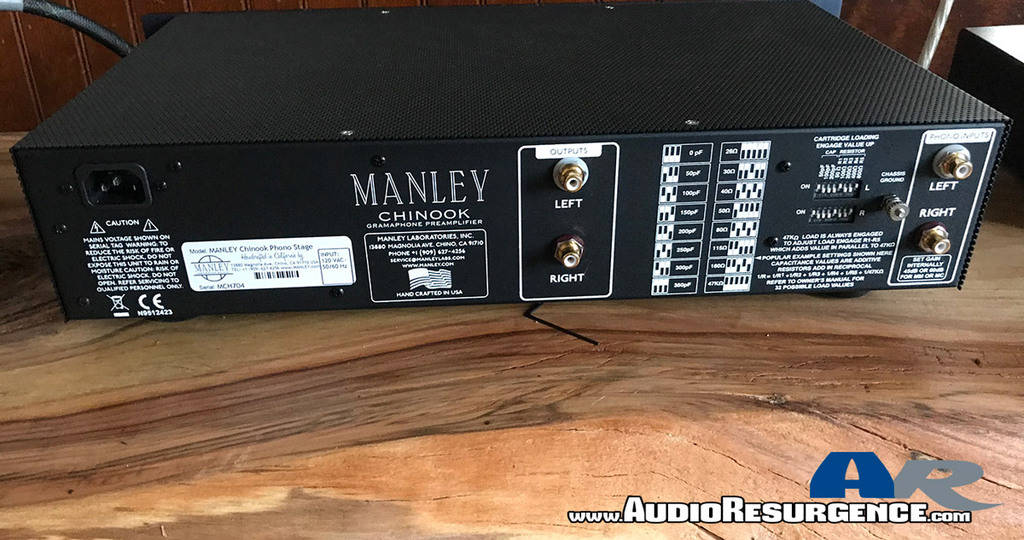
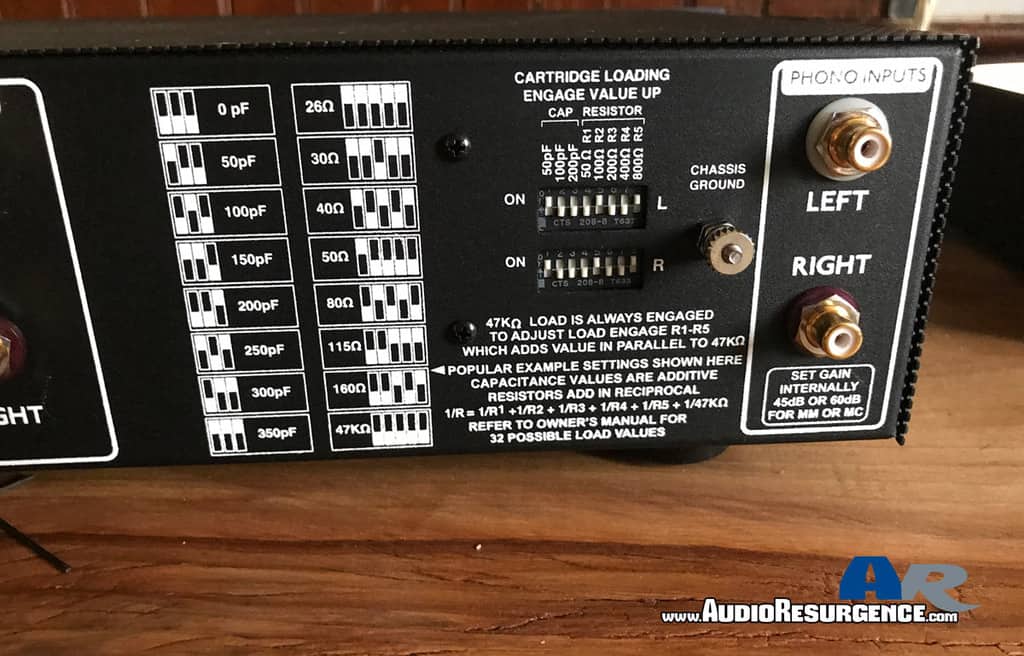
- 45 or 60dB of GAIN can be set internally. Why oh why couldn’t you put a toggle on the back?
- Options to match any Moving Coil or Moving Magnet cartridge. My ZYX with 0.24v output worked really well on the 60db setting.
- Two triode sections of a 6922 for amplifying duties with another 6922 dual triode serving as the output driver.
- Resistive and capacitance loading values with 31 possible options between 26 and 800 Ohms plus 47k Ohms. Who doesn’t love flicking around those shitty little dip switches with an unwound paperclip?
- 7 capacitive loading choices between 50 pF and 350 pF. A little down on options compared to Mr. Zesto.
- Unbalanced Input and Output connections.
- Made for music lovers! Ah, well then I’ll buy one.
OK, it’s got pretty much everything you need as a vinyl spinner except a remote. So yes, you may have to remove the lid at some point to switch gain, and you will need to get round to the rear of the unit to access those bloody awful dip switches.
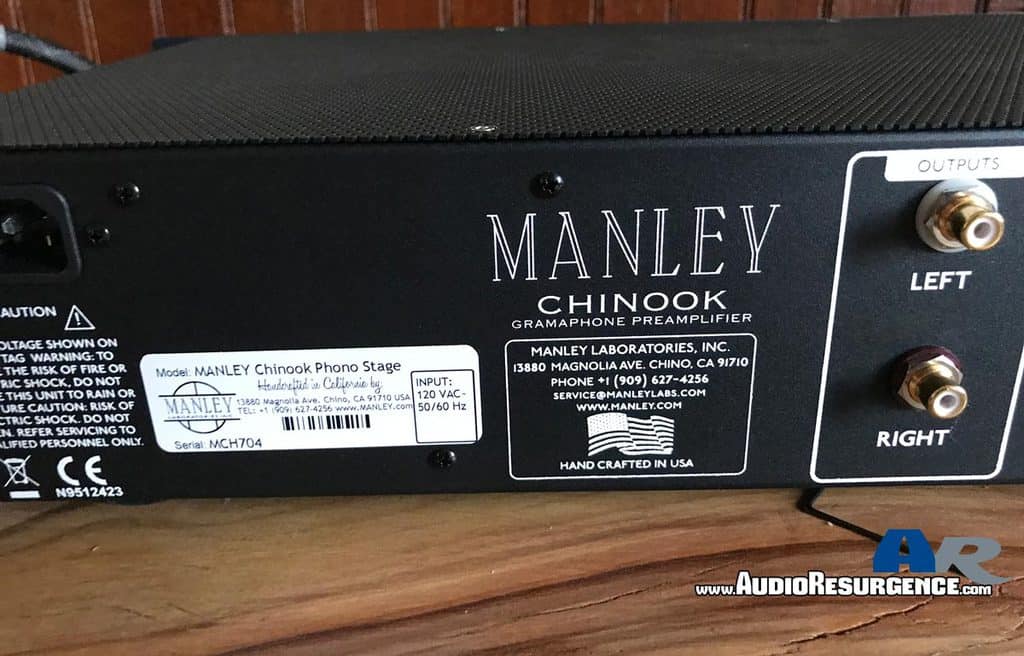
Build Quality / Appearance
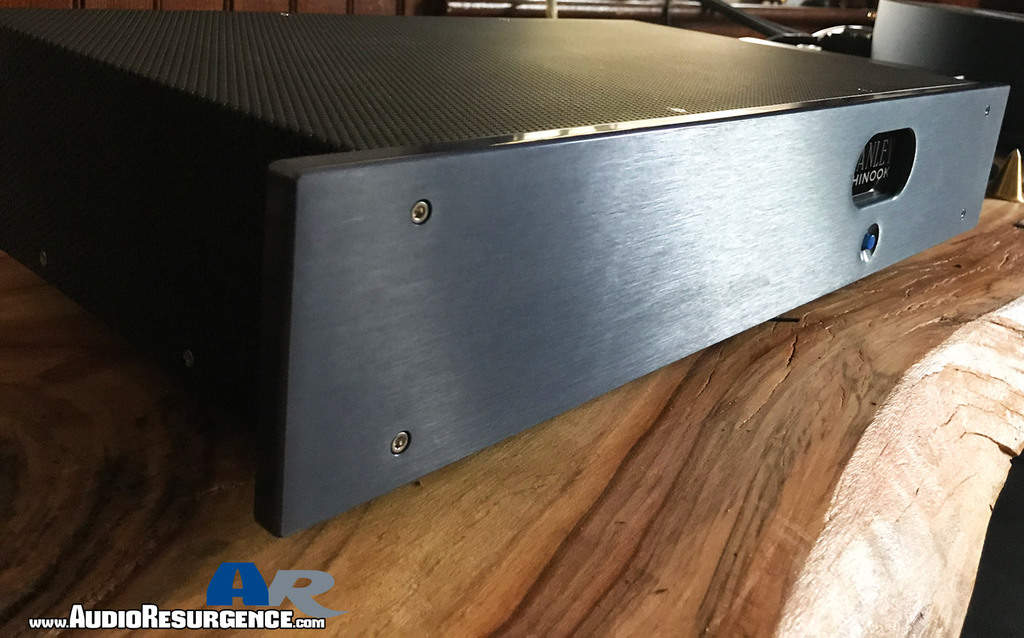
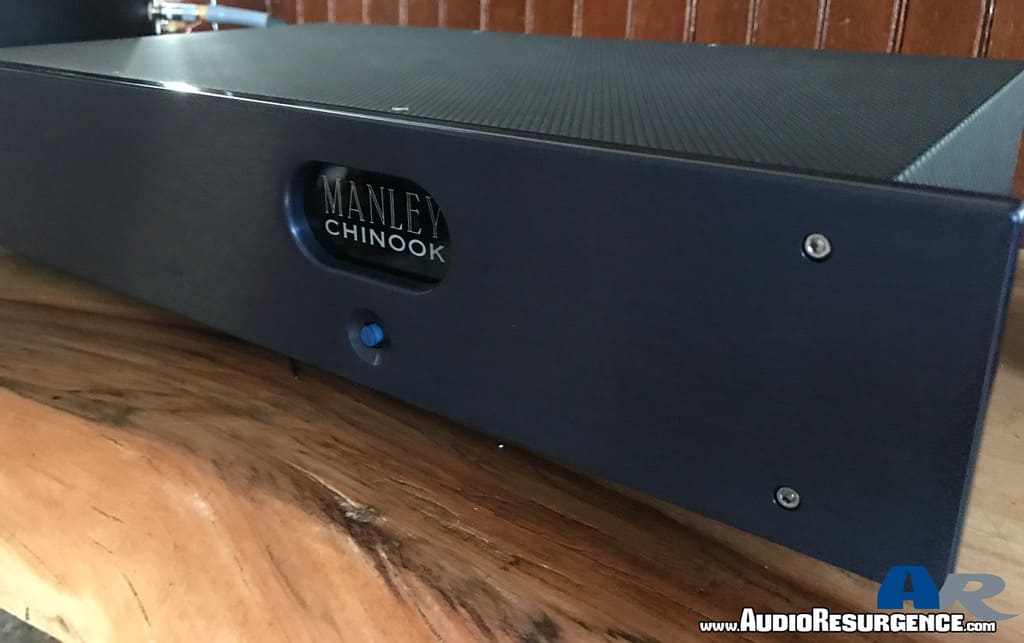
You’ll either be a lover or hater of the Manley retro/industrial look, personally I’m a little on the fence. Something like a Stingray integrated or even the Steelhead phono is a little too much 70’s for my tastes, but the Chinook is clean and neat and actually quite attractive with its lit Manley badge on the front.
Build quality is excellent. The case/chassis is solid and heavy and the internals are well laid out with not too densely populated circuit boards.
Dimensions are: W=19″, L=11″, H=3 1/2″ and the thing weighs a measly 15 lbs or thereabouts. I want a 48 ounce T-bone not a 6 ounce filet!
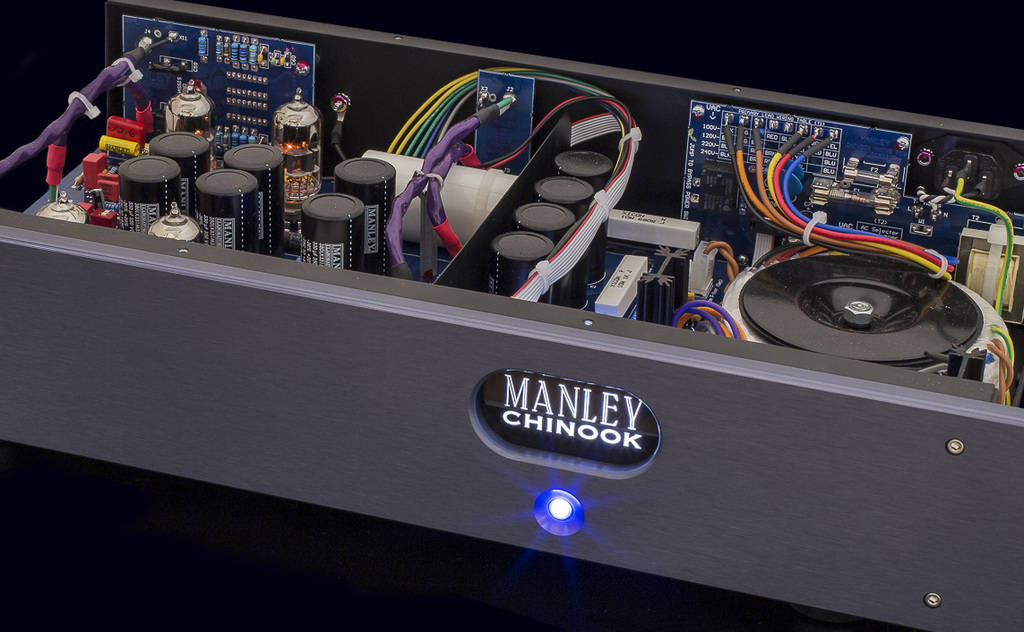
Photo courtesy of manley.com
Setup and Component Matching
I set the Chinook atop three AudioPoints and also tried it directly with supplied feet. I felt the AudioPoints helped de-saturate some of the density of image, which you’ll understand more when I talk about the sound.
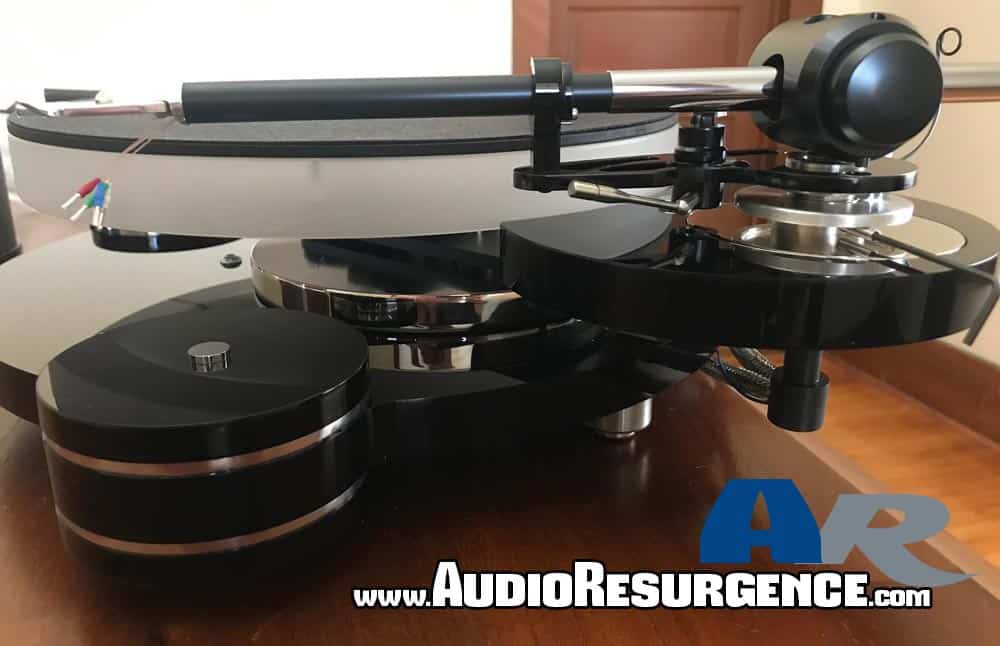
Cabling choices varied from the hard-wired phono cables on the Dr. Feickert Volare Turntable to cables from Analysis Plus, Harmonic Technology (Pro-Silway), Anti-Cables and several others I laid my hands on when switching this unit in and out. All of the cables worked well with the exception of the Level 2.1 Anti-cables, which in fairness were new and not broken in. Each cable brought a very small change to the sound, scarcely detectable in most instances, so I believe the Chinook to be free from any undue finickyness when it comes to hook-ups to the rest of your rig. With the Music Hall MMF-11 as source, I think the Pro-Silway edged out other cables going from TT to phono, and same on the phono to preamp.
I tried a couple power cords but settled quickly on the ESP Reference as I’ve only ever heard this cable make a positive contribution to the sound of the many different components I’ve used it with.
Setup was quick and easy. I had to remove the lid to set the gain to the lower 45dB initially, and flicking the dip switches on the rear of the unit is not my preferred way of making adjustments, but accepted as just one of those minor quirks that I have to learn to live with.
Switching on the unit there’s a 45 second warm-up cycle followed by a subtle click and you’re ready to roll.
The Sound Of Chinook
I didn’t spend any real time tube-rolling with the Chinook. It came with Tunsgram and Amperex NOS tubes and I had Electro Harmonix replacements on hand which sounded good in some ways, less pleasing in others. So the majority of listening was with the Tunsgram and Amperex NOS tubes. It’s worth mentioning that any 6922, 6DJ8, 7308, ECC88 tube can be used, so this is a tube-roller’s dream. Or nightmare, depending on your levels of OCD.
The sound of Chinook in my setup was big and meaty and gregarious, like an over-filled plate of mama’s best lasagna. Flesh on bones was the thing that really struck me most about the Chinook. It’s like stepping from a Krell Pre/Power combo to a classic Conrad Johnson setup. The music has presence, body, scale and nuance. As soon as my brain processed the increase in fleshiness it began (via my ears) to search for the obvious trade-offs – lack of dynamics, air and detail. But that wasn’t to be. Everything was there, where you’d expect it to be and with a pleasing musicality that few phonostages in my experience can muster.
Playing Duke Ellington’s ‘Blues In Orbit’ on 200 gram, (remastered by Bernie Grundman), the sound has excellent pace and vibrancy with images exploding out from a densely populated soundscape. Tracks like Three J’s Blues and The Swinger’s Jump have a high level of dynamic impact that helps give the performance a tremendously ‘live’ feel. Brass instruments have presence and solo horns pop from an inky blackness. The title track is a slow number that pitches Ellington’s piano in a duel with the horns. The sound of piano on this track is one of the best recorded pianos I’ve heard. The horns sparkle with just enough brashness and space around instruments is reconstructed wonderfully.
Since it’s my job to nitpick I have to say that the frequency extremes are where this phono preamp could be bettered. I found the bass to be quite extended but a little lacking in definition. An upright bass plucked and mixed into the background sounds sweet and fleshy and plummy but a bass synth or an electric bass placed more prominently in the mix doesn’t quite have the tautness and definition afforded by other phonos I’ve heard, particularly solid
Once the novelty of the Chinook had passed I spent an evening going through the usual audiophile check list, more for the benefit of my readers than myself. I’m going to save those results for a full Chinook review at a later date, and concentrate here on the differences between it and the Zesto Andros.
Next Up – The Zesto Andro and Comparisons With The Manley Chinook

CAPITAL AUDIOFEST 2019 SHOW REPORT

Components Used For this review
Music Hall MMF-11 / Project carbon 9cc with oracle audio damping kit upgrade / Goldring 2200 mm
Dr. Feickert Volare / Origin Live Silver / Ortofon Cadenza Bronze
Origin Live Resolution / Origin Live Illustrious / ZYX Ultimate 100
Thor TA 1000 MKII Preamp
Thor TPA 60 Monoblock EL34’s
Edge NL10.2 Power Amp
Tyler Acoustic D20 Speakers
Dunlavy Audio SC-III Speakers
HSU VTF-2 / VTF-3 Custom Modified Subs
ESP The Reference PC
Interconnects from Anti-Cables / Tara Labs / Harmonic Technology / Straightwire Maestro
Speaker Cables from Tara Labs / Anti-Cables.
Platforms And Isolation from Symposium / Audio Points / Mapleshade Heavy Brass Footers / Custom Platforms and Racks

Listening Notes
NEW!
We have an Edge NL 10.2 in the house! Review coming up soon – this is quite the amp!

Listening Notes
We have a Conrad Johnson ET-5 Linestge in the house! Review coming as soon as we can tear ourselves away from the Thor TA-1000 linestage!.

Listening Notes
We have a pair of Thor Audio TPA-60 Monoblocks and a Thor TA-1000 MKII linestage in the house!. Watch out for an upcoming review of these mind-blowing amps!

Listening Notes
We had a new Dr. Feickert Turntable in the house! Check out our listening notes and first impressions – Dr. Feickert Volare Review
DROP US A LINE. BETTER STILL, SEND US A REVIEW IF YOU WANT TO PUBLISH THROUGH US.
We’re always on the lookout for publishing partners and reviewers to take the load off yours truly.

Scroll Down For More Of Our Reviews, Listening Notes and Show Reports

Bookshelf vs Floorstanding Speakers vs the Room?
[Watch a short version of this article on YouTube...

The Law of Diminishing Returns in High-end Audio
I've been downsizing both my systems lately, and it...

Manley Labs Steelhead RC Phono Preamp Review
I’ve lived with the Manley Labs Steelhead RC...

SMR Cable Technologies Vanish 334 Speaker Cable Review
You know you're in for something serious when a set...

Spica TC‑50 Review: What $350 Can Still Buy You in High-End Audio
There are certain products in the audiophile world...

Vintage Linestages That Still Compete: Four Tube Preamps Worth Hearing in 2025
There’s great value in the vintage market. Not long...

The Midnight Effect in High-End Audio: Myth, Magic, or Measurable?
So I was up late last night listening to the system...

REL Carbon Special Review: High Expectations – Poor Results.
I’ve spent 18 months with the REL Carbon Special...

Tube vs. Solid-State Preamps: Magic, Myth, or Just Distortion?
Mick, from Downunder, just published a YouTube video...
Discover more from Audio Resurgence - High End Audio Reviews and Products
Subscribe to get the latest posts sent to your email.
