Review – Conrad Johnson CA200 Integrated Amplifier
MRP $6500
Used/Trade $3000 – $3500
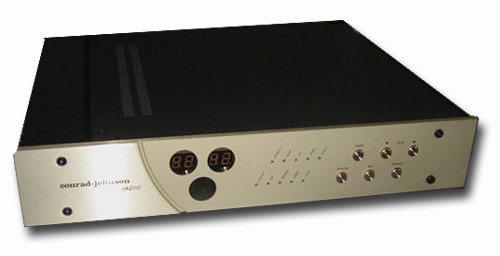
The CJ CA200 is no ordinary integrated amplifier. Typically, an Integrated Amplifier is two components (a preamp and a power amp) stitched together into a single chassis. The logic behind creating a single chassis ‘integrated’ unit is generally cost-driven. Rather than have two units, each with its own box, transformer, power cord and inter-connective cabling, why not combine them together into a single box and save on parts?
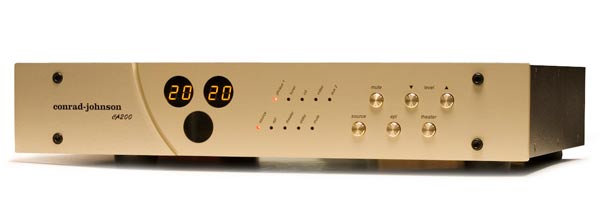 Generally, with an integrated amplifier there are some performance trade-offs when compared with the 2-box approach. By combining a power amp, with its inherently ‘noisy’ circuits, into the same box as a pre-amp, with its noise-sensitive circuits, and having both share the same power supply, there’s usually a negative impact on the resultant quality of sound.
Not so with the CJ CA200. And here’s why:
The CA200 isn’t your typical integrated amp, it is what Conrad Johnson term a ‘Control Amplifier’ (hence the ‘CA’ designation). Yes, it has all the switching and inputs of a well-equipped preamplifier and yes it has the power and control of a well proportioned power amplifier, but the way in which this is achieved inside of the single chassis is a little different.
You see, the CA200 has only one active gain stage; the preamplifier section of the CA200 is entirely passive. ‘So what?’, you ask. Well, by eliminating the gain stage in the preamplifier CJ are creating a simpler and more pure path for the audio signal to follow. Using a high quality stepped attenuator to adjust volume, and feeding the attenuated signal directly into the gain stage of the power amp section, the integrity of the audio signal is better preserved.
Well at least that’s the theory, but the proof of the pudding is in the eating, or in this case, the listening.
Before I get into how this unit sounds, lets just dispense with a few more technical niceties to satisfy any prospective owners.
Power rating
One of the draw-backs of an integrated amp comes from the fact that two components (the pre and power amps) are vying for the same space within the chassis. The physical size of the power components in a typical power amp (mosfets / transistors / transformer) are generally proportional to the output power of the unit. Since the power components are forced to share real-estate with the preamp components inside an integrated unit, the designers are generally required to keep the power components quite small. So most integrated amps are generally quite low powered, perhaps 100 – 125 watts per channel being the typical range. Not so with the CA200. Since there are no active circuits for the preamp, the power amp can be sized to offer an impressive 185 watts per channel into an 8 ohm loudspeaker load.
For whatever reason, Conrad Johnson do not provide a power rating for the CA200 into a typical 4 ohm speaker load. A quick email to the CJ service department resulted in a reply via the great Lew Johnson himself – 300 watts per channel into 4 ohms.
So that’s a nice healthy dose of power from an integrated amp, opening it up to a much greater selection of speaker loads than most competing lower powered integrated amps on the market.
Inputs / Outputs
You might be thinking that with an integrated amp, or in this case a ‘control amplifier’, the connectivity into and out from the unit might be limited or compromised. That’s absolutely not the case with the CA200. It boasts a comprehensive assortment of inputs and outputs, listed as follows:
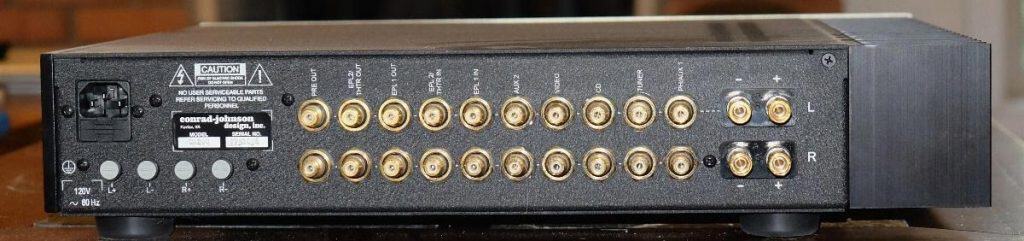
(Note, this is a non-balanced unit, all inputs and outputs are single-ended)
Sources – individual inputs are provided for PH/AUX, Tuner, CD, VIDEO, AUX2. These inputs are electrically equivalent and each presents a load to the source component which will not drop below 12 kOhms.
EPL1 in/out – Line level input / outputs for connection of an external signal processor.
EPL2/THEATER in/out – External processor loop for connection of a surround-sound processor. Level controls are locked to unity gain on the EPL2.
PRE OUT – you can use the PRE OUT to connect to an external power amp for bi-amp applications, or to an external subwoofer(s)
SPEAKER OUTPUTS – A single set of high quality binding posts which accept double-banana connections, spades or bare wire.
The unit is phase-inverting, so you’ll need to switch the +/- on your speaker leads at one end, to preserve the correct phase in your system.
So how does it sound?
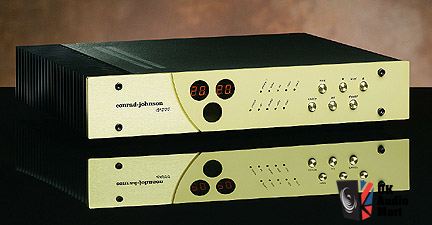 The Conrad Johnson motto for a decade or more has been ‘it just sounds right’. I can’t think of a piece of audio gear I’ve had in my system over the last decade more worthy of that tag-line.
Driving my QLN Signature Splitfield II speakers, the CJ is clean, clear, dynamic, extended, but above all – musical.
Many people associate Conrad Johnson with vacuum tubed amps, and of course, it’s via tubes that CJ gained their impressive reputation. The CA200 is not a tube amp, but it carries most of the sonic virtues of tubes without their weaknesses. Tubes are inherently warm and liquid sounding through the midrange frequencies. They offer a sonic bloom which many people find romantic and appealing. However, they can fall short at either frequency extreme, sounding a little soft and wooly in the lower frequencies and perhaps a little rolled-off at the upper high frequencies. The CA200 offers great bass extension, providing solid control over the woofers in the QLN monitors and wringing out a good half octave of additional extension compared with similarly powered amps I’ve used in the past. The top end is clean and extended without sounding harsh or ‘etched’. And the midrange which Conrad Johnson are famous for? Well it sounds quite glorious. It doesn’t have vacuum tube palpability, but it renders images in a full-bodied state with ample flesh on the bones. None of your stripped-bare solid state sound here.
Playing through a few reference CD’s and SACD’s, the CA200 proves itself consistently throughout the frequency range.
On Patricia Barber’s ‘Modern Cool’ recording, the upright bass is clear, full, tight and extended. Piano is exemplary with the CA200. It’s power delivers the incisive attack as upper-range keys are struck with force. Yet it never becomes hard or harsh, as so many solid state amps tend towards.
One of the CA200’s strengths is the ability to create a realistic soundstage. The stage depth easily extends beyond the boundaries of the speakers, when the recording permits. Depth is first class too, with solid images occupying space in a stage pushed back 8-10 feet behind the speakers.
Presentation is perhaps mid-hall, the entire stage is reticent, pushed to the rear of the speaker with little projection forward of the front plane. If you like your images to project out into the room, then you can push your speaker back towards the front wall to give more of a forward standing image.
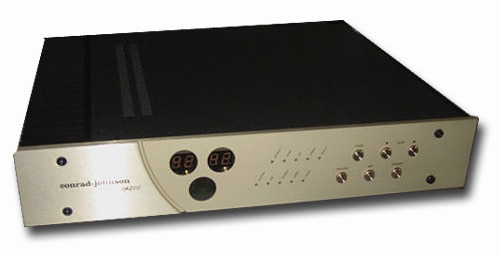 When comparing the CA200 to the more powerful Odyssey Stratos Glass Ceiling monoblocks, there seemed to be little sacrificed in the power stakes, at least when driving a sensible speaker like the QLN Signature. The Odyssey is voiced a little on the warm side of neutral, which is pretty much where the CA200 sits too. Not warm in an overly colored or syrupy sense, just a tad closer to a neutral tube amp than a neutral solid state amp. The CA200 yields very little to the more powerful Odyssey amps and given the smaller footprint and weight of the power supplies, that’s quite an achievement.
Since what sets this little amp aside from its competitors is power, it was interesting to see just what it could do when pushed hard.
On hand for this review I had my reference set of Carver Amazing loudspeakers and I couldn’t resist seeing how the CA200 would handle an extreme load. The Carver Amazing’s are a dipole system with a 60” Planar Magnetic ribbon and 4 x 12” dynamic cone woofers per speaker. The efficiency is around 83db/w/m and the impedance dips below one ohm at certain frequencies. This is a monster of a load which has brought amps with a much higher power rating to their knees.
Obviously, in a real-world scenario one would never seek to pair a Carver Amazing with a 185w integrated amp, but it was interesting to hear what kind of noise the CA200 would make when pushed to clipping. For those unfamiliar with the term ‘clipping’, when an amp is overdriven (asked to provide more power than it is physically capable of), then it starts to operate outside of its design parameters and starts to ‘clip’. Clipping is essentially a type of waveform distortion which is always audible. Just how audible varies from amp to amp.
Driving the Carver Amazing, the little CA200 retained all of its magic at moderate listening volumes (75-80db). As the volume controls were opened up, the CA200 never became harsh or exhibited any kind of audible stress, it merely became closed-in and the stage width and depth began to diminish in scale.
What this tells me is that the CA200 has a well-designed power supply and a well executed power circuit. It seemed to handle being over-driven with relative ease and comfort, which tells me that it has more than enough dynamic headroom to handle any practical speaker system on the market.
Conclusion
The Conrad Johnson CA200 can compete with any amp I’ve heard in my system in terms of sheer musicality. It’s ability to perform well through the frequencies and add just a tad of midrange warmth gives it a sonic character which will appeal to anyone who values musical enjoyment over performance specifications.
Paired with a 8 or 4 ohm speaker of 85db or higher, it should have more than enough drive and current capacity to play at realistic volume levels and still have sufficient dynamic headroom to handle dynamic peaks and transients.
When you think that this unit is basically a CJ Premier 350 ($9500) and a CJ Premier 18LS ($3500) in a single chassis, it represents excellent value for money at exactly half the price of the two units. Though certainly not inexpensive at $6500, it performs at a higher level than its price suggests and easily competes with pre/power separates costing $10,000 and more.
A hearty recommendation for a product backed by the impeccable reputation of one of the most sought-after brands in the industry.
Rooze
Associated Equipment on-hand for this review:
- Cambridge Audio Azur 851C CD player / DAC / Preamplifier
- Pioneer DV47ai Universal Disc player
- Odyssey Stratos Mono blocks (Glass Ceiling Version)
- Sunfire 300 Amp.
- Carver CT7 preamplifier
- QLN Signature II Splifield with outboard XO
- Apogee Caliper Signature planar magnetic speaker
- Carver Amazing Ribbon Speaker
- Various cables from Alpha-core Goertz, Analysis Plus, Virtual Dynamics, Anti-Cables (Magwire).
Discover more from Audio Resurgence - High End Audio Reviews and Products
Subscribe to get the latest posts sent to your email.