

This is part 4 of a series focused on improving the performance of a pair of Altec Lansing Valencia 846b speakers. Here’s what you’ve missed so far:
Part One – Altec Lansing Valencia 846b Review
Part Two – Adding Aperion Audio Supertweeters to Altec Lansing Valencia 846b
Part Three – Dampening Altec Valencia 846b Horns (Altec 811-B)
Part Four – Using the Lyngdorf TDAi 2170 for Digital Crossovers and Room Correction
OK, I finally got around to hooking up the Lyngdorf TDAi 2170 “Integrated Amp” with the Altec Valencia, so it’s time to share a few notes in the form of a mini-review.
There’ll be those of you who own vintage speakers and might be giving serious thought to using an electronic (active) crossover, so this review is for you. If you’re more on the fence and just want to know ‘yay or nay’, then I’d recommend skipping all of the detail and just jumping ahead to the conclusion of this exercise, which is here.
I won’t clutter this page with a full list of specs for the Lyngdorf unit, if you’re interested to know more about this product you can visit the Lyngdorf website here.
I will however provide a quick overview of this device’s impressive list of talents:
- It functions as an integrated amp, with a variety of inputs suitable for both 2-channel and Home Theatre use.
- It has a built-in DAC (not exactly a conventional DAC, per se, but for the purpose of this review it’s better to keep things simple and refer to it as a DAC).
- It supports digital inputs in various formats including USB, SPIDF, etc. (The USB input is via an add-on module, as are the HDMI inputs.)
- Its power amp section delivers 170 watts into 4 ohms with a peak 30A output capability.
- It comes with Lyngdorf’s proprietary ‘Room Perfect’ room correction software, more on that later.
- It has inbuilt active crossover capability, more on that later.
Note – My unit arrived with the optional boards/modules as follows:
- High-end analog input module (no phono)
- USB input module
- HDMI input/output module

To quote from Lyngdorf’s website:
“The TDAI-2170 is 100% digital, without sound-deteriorating digital-to-analog conversions. The digital signal drives the speakers directly, with no translation and no middleman. This unique and technically demanding solution offers noiseless and crystal clear replay at all sound levels. It will deliver the most enjoyable and uncolored sound you have ever experienced.”
Now, this isn’t the first unit from Lyngdorf that I’ve owned, so I’m familiar with its operation. The TDAi 2200 that I owned some years ago was reviewed here, and it’s essentially the same unit as this newer TDAi 2170, the older unit having a bit more power, the newer version benefiting from updated software.
The ‘exciting’ thing here is that the TDAi 2170 has the ability to replace a lot of expensive hardware in my system along with some ugly room treatments.
Potentially, I could make the following items redundant –
1 – The Great Plains Audio premium Model 19 crossovers
2 – Veloce Platino LS-1 battery-powered linestage and battery power pack.
3 – Denafrips Terminator DAC
4 – Denafrips GAIA DDC
5 – Various expensive power cords and interconnects
6 – Associated racks and isolation gear.
Add up the resale value of that little lot and we’re generating around $10K, minus the $3K for the TDAi, so a net gain of around $7,000 to spin into other gear, potentially.
If you’ve noticed, I keep using the word ‘potentially’. Quite simply, the Lyngdorf approach needs to yield better sound quality than that achieved via the other more conventional approach for me to want to jump ship. I’m not trying to save money here, I’m trying to make my system sound better.
To help understand the mechanics of what’s going on, I need to explain briefly how my system is arranged now, and how it will look with the TDAi 2170.
- I have 3 source components, a turntable with an outboard phono stage, a streaming setup using Sonore UltraRendu and Sonic Transporter i5, and SACD/DVD via an OPPO 95. These three things will remain unchanged.
- The Denafrips DAC and DDC will be removed and replaced by the DAC in the Lyngdorf.
- The Veloce Linestage will be replaced by the preamp features of the Lyngdorf.
- The GPA passive crossover will be removed and replaced by the active XO feature of the Lyngdorf.
- I will also be removing a pair of passive subs from the system, as they add little to the capabilities of the 15″ woofers in the Altec Valencias.
OK, that’s the gear side. But what am I aiming to improve in terms of sound, anything specific?
Project Goals
Yes, there are a couple of specific things. I’ve talked in early posts concerning the Valencias that they’re very much rolled-off and quite dark sounding. I described the project introducing the Aperion Audio super tweeters in my previous post, and they helped quite a lot with the HF. But I’ve never felt happy with the GPA crossovers and certainly not with the way in which I’ve lashed them into the system.

Great Planes Audio Altec Lansing Model 19 crossovers
When the speakers first arrived I basically plugged everything in as I’d had it presented to me by the previous owner. His was a lash-up, so I duplicated the same arrangement with the intention of coming back later and making a better job of it all. That would’ve involved purchasing project boxes and parts to place the GPA crossovers in boxes with binding posts, etc. That never happened. Great Plains Audio, despite selling the crossover as a viable upgrade over the original 846b crossover, do say on their website that going ‘active’ is a better solution to their passive design. They suggest the use of a Driverack active system, a component on which I wasn’t about to spend the rest of my days trying to learn and understand. (I read the manual, it’s complicated).
So it would be nice to make the GPA XOs disappear, and that’s Goal #1.
Goal #2 is to fix a midbass hump that I haven’t been able to fix by moving the speaker in the room. I’ve lessened the problem, but it still persists and really bugs me on certain types of music. I have an inkling, based on previous experience with Lyngdorf’s Room Perfect software, that some quality room correction might help.
Goal #3 is to make the speakers sound a little more dynamic and transparent and to lift the HF output to recover more detail from recordings. While the super tweeters certainly help in this regard, they don’t fix the other issues described above.
So the above goals are the primary objectives I’m looking to achieve by adding the Lyngdorf TDAi 2170. If there are other positive spinoffs, as I believe there might be, then that would be nice too.
Getting The Lyngdorf Set Up
There are different ways to approach this. There are 3 outputs from the TDAi 2170 to consider, each capable of having a low or high pass active filter:
- The Lyngdorf’s own amplifier and speaker binding posts.
- The Analog audio output
- The digital coaxial output.
I decided to use the speaker outputs (internal amp) to directly drive the Valencia’s woofers, and to use the analog output on the TDAi 2170 to feed into the First Watt J2 to drive the horns. So it looks like this:

With the TDAi one can adjust the low and high pass crossovers in the following ways:
- Crossover types can be selected between Butterworth and Linwitz Riley first, 2nd, 3rd, and 4th order slopes
- A distance can be entered on any of the outputs, to indicate a driver might be physically misaligned from other drivers in the forward/backward planes. This is used for example when one is controlling subwoofers via the Lyngdorf and the subs are set back, physically, from the main speaker pair. The delay is entered in centimeters.
- A fixed time delay can be entered on any output to compensate for sending signals into other amps, such as in the arrangement I’ve used above. The delay is entered in milliseconds.
So with the above parameters, one has some ability to time-align the drivers to compensate for any timing anomalies that might manifest as phase-shift in the sounds generated.
I started out using the LR 4th order setting since this is the most commonly used type of audio crossover, made by cascading two 2nd-order Butterworth filters. Their slope is 24 dB/octave (80 dB/decade). The phase difference amounts to 360°, i.e. the two drives appear in phase, albeit with a full period time delay for the low-pass section. Reference at WIKI here
My crossover frequency was initially set to 800 Hz on both high and low pass, a value set by the factory in the original N800-8K crossover.
I’m not a speaker designer, but managing this limited number of parameters seemed doable, even for a klutz like me. I was expecting to have to go back and forth quite a bit with experimentation, but surprisingly, it sounded quite good from the get-go. I did have to compensate for the mismatch in gain between the Lyngdorf’s own speaker terminal output and that of the First Watt J2 amp, however. This was simple enough and was done by ear. I finished up with a minus 4dB gain on the Lyngdorf’s own driven output, which created a good integration between the woofers and horn-loaded mid/HF drivers.
Bingo.
Discounting the time for getting the TDAi into the system (digging out a suitable PC and cables and just getting the hardware in place), the whole process took less than an hour. Much of that was remembering how to use the menu system on the Lyngdorf, which was basically the same as the system I’d had on the older TDAi 2200 around 8/9 years ago.
Should anyone decide to go down this same path, or perhaps a similar path with a different 2-way speaker design, I recommend getting the system to sound right before stepping on to using Room Perfect. I spent an hour listening to familiar tracks before moving to the next stage of room correction. What I was hearing pre-room correction was OK, but wasn’t great. It was clear at this stage that the Great Plains Audio passive crossover had been a great bottleneck and barrier to good sound. Without the GPA XO, and now using active XOs in the TDAi, the horn sound was far more extended, resolving of detail, but also a little bright sounding and harsh. The 800hz on down range handled by the woofers still had the annoying midbass hump, but the higher-powered amp in the Lyngdorf had a better grip on the bottom end, and it was clear that I probably wouldn’t be needing subwoofers for the bottom octave.
Room Perfect Setup
So a couple of hours in and I was ready to fire up Room Perfect. The process couldn’t be simpler with the Lyngdorf. If you’re hesitant about going down this route due to some perceived complexity, don’t be. This is fool-proof stuff and so simple to do. Basically, putting together the damn stand for the microphone was the most technically challenging aspect of doing the Room Perfect setup!
Once the stand is assembled and the supplied mic inserted, connect the mic to the back of the Lyngdorf then place the mic at the listening seat, exactly where your noggin would be. Then go to the Lyngdorf, enter the menu > Room Perfect, and go through the setup steps as prompted on the display. (It would be nice to be able to do all of this, and the XO programming, etc, from a tablet app. This is available on the more expensive models but not the 2170).
Once the listening seat position has been measured, you’ll be prompted to move the mic around to other random positions in the room, one by one. Each time the TDAi will output a series of test tones through the speakers, with the mic capturing the tones to record the room’s response to all frequencies. Each time you record a position in the room, the software will show a ‘percentage’, which is basically how much data has been captured about the room. You’re aiming for between 98% and 100%, so this may require you to measure around 7-10 positions or more. From past experience with Room Perfect, it sometimes stalls out at 99%. That might be due to an odd/misshaped room, a particular type of speaker, or some other reason, but with the Valencias I was able to hit 100% after 7 room measurements. The whole process took around 15 minutes.
Once measured, the settings are stored in memory and the Lyngdorf calculates and automatically applies the necessary EQ parameters to the system. At which point, there’s nothing else to do other than to sit down and listen.
CLICK TO EXPAND
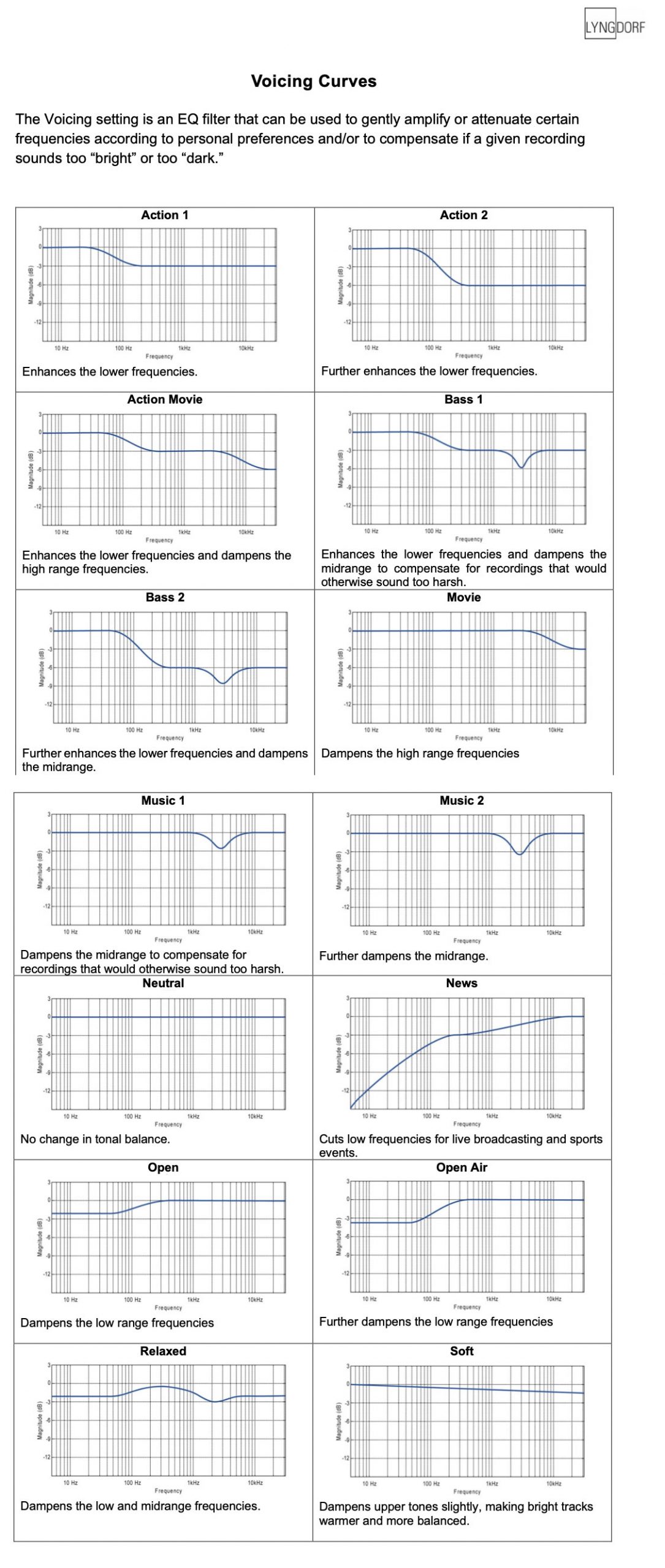
There’s a useful feature in this version of the TDAi that I didn’t have in the older 2200 – and that’s the ability to implement a wide range of ‘Voicings’. I’ll show you these before I talk about how things sounded post Room Perfect setup. Here’s the diagram – pretty self-explanatory, just click to open:
First Listening Session
So with all of that out of the way, how do things sound?
Well, I have to say that there’s a sonic transformation with the Lyngdorf at the helm, at first blush, mostly for the better, but with one or two important caveats.
Firstly, the horn on the Valencia is capable of very good high-frequency performance, so I’ve just discovered. There’s nothing lacking with that horn/driver combination, (High/Mid Frequency Driver: Altec 806-8A / High/Mid Frequency Horn: Altec 811-B) once the passive crossover is removed. What I do notice, with the constraints of the passive unit removed, is a little more harshness and resonance from the horn. Part way through this whole process I went ahead and removed the horns to install the dampening material that’s been sitting in the closet for the past few months.
On the midbass issue, I would estimate that probably 95% of the issue is gone, or put another way, it’s 95% better than before. My take on the Altec 416-8B driver is that it’s fairly competent but hardly world-class in its performance. So midbass on down is always going to be a little compromised with the Valencia, assuming you hang on to the original drivers. Moving to an active crossover can’t fully overcome the inherent limitations of these units, but it can help a lot.
Low-bass performance is improved also without the passive XO, and also perhaps with the addition of the higher-powered amp (in the Lyngdorf) with its higher damping factor. Bass is certainly a little more extended than before, but it’s also a little more taught and tuneful. I can also ‘feel’ the lower frequencies more than before, and I can, as hoped, finally ditch the subwoofers.
The midrange has suffered a little. With the extended HF performance it has certainly shifted the overall tonal balance of the speaker and there’s now less emphasis on the midrange. This is a significant step backward and the main caveat I mentioned earlier, but it might actually be resolvable, to some extent. In some ways, the process has taken what was a very stereotypically ‘classic’ or ‘vintage’ sounding speaker and turned it into something more modern. But in doing so, the speaker has lost much of its charm and appeal.
I lived with the sound for a couple of lengthy listening sessions, before heading back to the drawing board, something just didn’t sound right.
Changing Crossover Frequencies and Slopes
I ventured back to the GPA website to re-read their article on going active with Valencias and realized I’d made a bit of a booboo. The error was born entirely from a fading memory. I’ve read the information on that article a number of times and noted that the Valencia 846b had its crossover set (in the original) at 800hz, but on the Model 19, that was revised to 1200hz. And since I’d been using the Model 19 XO (as many do), I’d done all of my listening thus far with a 1200hz XO point. I’d now reverted back to the factory original setting of 800hz and things sounded brighter, less warm in the midrange, a very different tonal balance than I’d become accustomed to. The article goes on to describe their own favored results using a Driverack active XO/EQ system and that they’d settled at 1.35kHz and a 12db Butterworth filter on hi and lo pass. That should’ve been my starting point, why reinvent the wheel?
Fortunately, with something like the Lyngdorf, it’s quick and easy to make the changes. Had I ventured down the route of using a Marchand electronic crossover, I would’ve needed to order different XO boards (on the model I was interested in purchasing), or become handy with a soldering iron, which I’m not.
With the 1.35kHz and 12 dB Butterworth filters set, there was an immediate improvement in tonal balance. I now recognized the sound of the Valencia, the one I’d been listening to and preferring over my far more expensive Piegas, for many weeks.
Final Listening Impressions
If you remember from the start, the project goals were to:
#1 – Identify weaknesses in the GPA Model 19 crossovers and remove them from the system if they indeed turned out to be a bottleneck in performance.
#2 – Fix a midbass hump that I haven’t been able to fix by moving the speaker in the room.
#3 – Make the speakers sound a little more dynamic and transparent and lift the HF output to recover more detail from recordings.
I can safely say that all three of the above goals have been accomplished.
You’ll also remember that this wasn’t merely an exercise in eliminating hardware from my system, the end result had to be that the overall sound quality is improved. And that’s where I’ve kinda come a little unstuck. With the Lyngdorf in the system, the GPA crossovers sit idle in their little shoeboxes, the Volace LS-1 line stage, the Denafrips Terminator DAC, and the Denafrips GAIA DDC, all site in standby mode, casually looking on.
But what I’m hearing with the Lyngdorf TDAi 2170 at the heart of this system is what I can only describe as a ‘course digital signature’. There’s a lack of continuity to the sound that harks back to the introduction of CDs in the early 80’s. There’s all of the air, detail, extension top and bottom, and enough, I believe, to please most resolution-hungry audiophiles. But that vintage magic has disappeared. I’m no longer able to just relax into the music and be transported off to the recording space. I’m constantly made aware that this is recorded music being played back on a home HiFi system – the ability to suspend disbelief is gone or is greatly diminished. There’s a subtle but ever-present hardness to the sound of instruments and vocals. The naturalness that I’ve enjoyed for many weeks has largely disappeared.
The Denafrips Terminator DAC is an amazing bit of digital kit that comes as close to the sound from a turntable as I’ve heard. Eliminating the Terminator and using the Lyngdorf as a DAC, that pure/analog sound is largely gone. Adding the Terminator back into the system and using the analog input on the Lyngdorf didn’t help any. So it seems the damage is being done elsewhere and not in the DAC stage itself.
The peculiar thing here is that I’ve heard Lyngdorf equipment with a highly resolving horn system in the past and it sounded anything but digital. In fact, the older TDAi 2200 redefined what digital amps were all about, for me at that time. So what gives? All I can think is that using the active crossover has tipped the unit over the edge and altered its overall sonic signature and its capabilities. Perhaps the XO function isn’t as carefully designed and integrated into the control scheme as the DAC, the amp, or all of the other features of the TDAi 2170. I can’t say for sure where the problem lies, but there are ways of finding out.
There are things to try, but I’m not optimistic that they will help. I can eliminate the crossover functions of the Lyngdorf and reintroduce the passive XO. Then, hope that somehow the Room Perfect system extends the frequency range to fix the rolled-off sound associated with the passive XO. I’d be surprised if that worked, I don’t think that’s what Room Perfect is. I could switch off the high pass filter in the Lyngdorf and add a capacitor, with the value set to cut frequencies to the horns above 1350 hZ. That would either prove or disprove that the internal XO of the TDAi is at fault. I suppose that would be quick and easy to accomplish. But I’m not hopeful of a positive result.
At this point, I’m inclined to think that my journey with the Altec Valencia has gone as far as I’m willing to go. On the positive side, I have to remind myself that whilst listening to the Valencias, there’s a second room and system over my shoulder that’s home to a $35K pair of Piega speakers and some other really nice gear. But for the past few months, I’ve spent the vast majority of my time listening to the Valencias. The ‘experiment’ above has told me that there’s so much more to be had from these vintage speakers and that the key to unlocking their fullest performance is almost certainly in reworking the crossovers. The Lyngdorf approach, for whatever reason, hasn’t worked out, but it has yielded important information about the upper limits of these speakers, they are indeed capable of much more. But now that I’ve heard what they’re capable of I can’t just put the genie back in the bottle and go back to using them with the GPA passive crossovers.
And I just don’t know if I want to walk any further down this particular path.
I’ll stew on things for a while then perhaps come back here to post an update. If you have an opinion or some advice on any of this, please share using the comments box below.
Cheers
CAH June 28 2022
[Comparison of the: Altec Lansing VOTT A7 vs Klipschorn vs Altec Lansing Valencia 846b]
Discover more from Audio Resurgence - High End Audio Reviews and Products
Subscribe to get the latest posts sent to your email.


Does the Lyngdorf have setting for phase shift?
Cool series of articles. Any reason you did not try a DriveRack like GPA did? I understand you get a lot in one package with the Lyngdorf but it must challenging to determine what contributes to what, no?
Yes, I considered the Driverack and downloaded the manual to get a feel for what’s involved. I decided the learning curve was too steep for me to take on. I emailed Great Plains Audio and asked if they’d be willing to send me their config file for the Driverack and I offered to pay them for it. As is common with GPA I heard nothing back.
Cheers
To be completely honest, I was initially skeptical, but as I alternated between the TDAI and my meticulously calibrated reference system (using 20 microphone positions), I can confidently state that the TDAI-2170 outperformed my system in two-channel audio by a significant margin.
just read thru ur article about the Altec Valencia upgrade with Lyngdorf TDAi 2170, really insightful stuff! I’m kinda curious about something tho. U mentioned that the Lyngdorf’s digital crossover might have changed the sound signature too much. Do u think there’s a way to tweak the settings or maybe a different crossover approach that could bring back some of that vintage charm, while keeping the clarity and detail? Been thinking of upgrading my own setup, so really wondering how to strike that balance. Thanks a bunch!”