Reviewing cables isn’t the most exciting job on the planet, my review of these Iconoclast RCA Interconnects will prove that it’s not so exciting for the reader, either….
A while back I reviewed two sets of Iconoclast speaker cables, and after living with them for a few months decided to upgrade several other cables in my main review system to the Iconoclast brand.
I’m not supposed to say this as a reviewer (word ‘reviewer’ provided and intended for use in its loosest sense), but reviewing cables isn’t the most exciting job on the planet, so I tend to avoid it where possible. But every once in a while I find a cable that’s genuinely worth crowing about. That has certainly been the case since discovering the Iconoclast brand. My review of the Iconoclast speaker cables can be seen by clicking the link above, but in a nutshell, I found the cables to be detailed and resolving, transparent, and dynamically astute both in the micro and macro sense. The speaker cables are very linear and without any emphasis on any one part of the frequency range, they do not color the sound in any way that I can discern.
I took a flyer on purchasing the Interconnects, based solely on my experience with their speaker cables. While I’d had the speaker cables here for a while before deciding to send the home-demo samples back and buy two new pairs (for biwiring), I’d never heard their interconnects before placing the order for the following products:
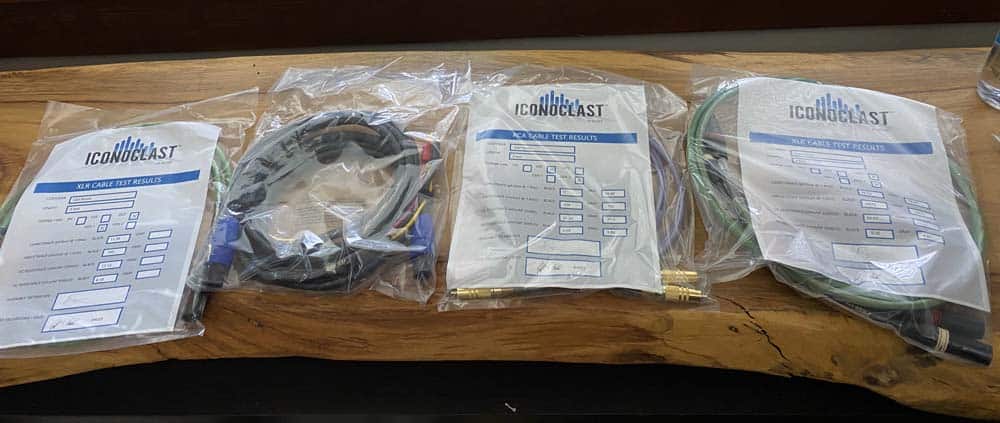
- Iconoclast OFE 4×1 RCA Cables (pair), 5-foot ($800) (Subject of this review)
- Iconoclast OCC 4×4 XLR Cables (pair), 4-foot (Review to follow)
- Iconoclast OCC 4×1 XLR Cable (single), 5-foot (Review to follow)
- BAV 1310A REL-compatible subwoofer cable (single, three-wire), 8-foot (Review to follow)
It’s worth a trip over to the Iconoclast website to learn more about the science behind their cables, but I’m going to borrow two paragraphs so you can see the specs of the specific cables under review:
Conductor Options: There are three options available for the signal conductor composition (shielding is TPC on all varieties). The difference between these is purely one of material, and not of design; regardless of whether your cable is made with TPC, OFE or OCC, the internal structure is the same, and the termination methods and hardware are the same.
The conductor choices for XLR cable are TPC, OFE and OCC. TPC is Electrolytic Tough-Pitch Copper, widely used in communications cable of all sorts. OFE is Oxygen-Free Electrolytic Copper (99.99% pure); OCC is Ohno Continuous Cast copper (99.99998% pure). The outer jacket color is red for TPC, violet for OFE, and green for OCC.
Iconoclast OFE 4X1 RCA Cable
I started out by placing the 4×1 OFE RCA cables between my Manley Labs Steelhead Phonostage and the Veloce Audio LS-1 preamp, and then later between the Holo Audio May KTE DAC and the Veloce Audio LS-1 preamp. (Equipment list at end). Cables on hand for comparison included Harmonic Technology ProSilway IIs, a pair of Cardas Golden Cross, and a pair of relatively inexpensive Anti-Cables III.
Differences noted and comments made appeared consistent when using these cables both from the Manley Steelhead phonostage to the preamp and from the Holo May KTE DAC to the preamp.
I started by setting a playlist on repeat to get some break-in time with the cables between the DAC and preamp. With around 200 hours on the clock, I moved the cables over to the vinyl rig to start doing some serious listening.
With the Nottingham Analogue Hyperspace > Manley Steelhead front-end, I’ve always found the sound a little overly analytical. There has been a persistent hardness on high frequencies and some excessive vocal sibilance that I haven’t been able to fully shake off since bringing home the Nottingham Analog rig to replace my long-trusted Basis Audio Debut. I’ve played with VTA, and VTF, and used cartridges that sounded fine on my previous table, but the Nottingham deck always seemed to be a little too zesty on the top end. So I moved to identifying and trying to resolve the issue with cable changes. I’d previously switched out a relatively inexpensive Cardas phono cable for a more costly Nordost Heimdel II, and still the issues persisted. I then moved to the RCA cable between the Steelhead and the preamp. I replaced the Harmonic Technology ProSilway II I was using with a Cardas Cross RCA. This removed (masked?) the sibilance but the sound lost much of the openness, clarity, and transparency – it became overly warm and lacking in resolution. The Anti-Cables RCA (series III) has been a cloudbuster in the past, able to punch well above its price point in some configurations, then fall flat on its face in others. It worked okay but it was a little too close to the Cardas in terms of adding unwanted warmth and colorations to the sound. Well, to my surprise, with the Iconoclast 4×1 OFE, that little bit of graininess and grittiness disappeared completely, and with no discernible negative side effects.
If you’ve read any of my previous reviews involving vinyl playback you’ll know I’m a fan of the Tears For Fears album, ‘The Seeds of Love’ from Mobile  Fidelity. This album can sound harsh and strident on the wrong system or if things are not properly dialed in. It can also sound pretty impressive when everything is just so, and that’s how it sounded out of the gate with the Iconoclast OFE. Being the skeptical type I figured I might just be getting a slightly rolled-off top end due to the cable being new and not fully broken in, with only a couple hundred hours or so on the clock. I played a few more album sides, then at the end of the session, I pulled the cables and threw them into my second system between a PS Audio DSJ DAC and preamp and set up another playlist on repeat, this time on the Lumin U1 Mini, then went about my business while letting the Iconoclast cables cook for another few days.
About a week later and with at least 400+ hours on the cables, I set about giving things another listen on the main rig. Listening to the same Tears For Fears album, the top end was just as I’d heard it after the 200 hours or so of break-in mark had passed, only perhaps now with a tad more openness and clarity. This time I heard more air around cymbals, more sparkle and detail, and, thankfully, still no edginess or sibilance. Great!
Spinning some trusted evaluation discs, and later resorting to having to listen to music I actually enjoyed, I quickly picked up on what I described in my review of the Iconoclast Speaker cables as the ‘Iconoclast house sound’. These cables exhibit a consistently linear and unified frequency response across the entire spectrum, without accentuating any specific frequency range. I consider this level of linearity and coherence to be rather uncommon, and it often goes unnoticed until comparison with other cables lacking these attributes. It’s so unique in my experience that it has become identifiable as a ‘house sound’. For example, switching in the Cardas Cross cable, I hear a midbass emphasis that’s creating an artificially warm tonal balance from the cable, one that the Iconoclast cable does not have. The Harmonic Tec ProSilway II cable in the same position is peaky in the higher-frequencies, causing that top-end harshness and sibilance that I mentioned at the start of the review, harshness that the Iconoclast cable does not have. Most other cables I’ve used over the years introduce some form of coloration. It isn’t always an unwanted coloration, sometimes tone controls can be a blessing in certain system configurations.
As I’ve alluded to above already, the more stark contrast in presentation came between the Iconoclast and the Cardas Cross cable, which more by chance than design both retail iro $800. The Hamonic Tec ProSilway II was much closer in performance to the Iconoclast, with the most noticeable difference being in the higher frequencies where the HT ProSilway sounded more edgy and less refined.
So using the Cardas Cross as a comparative tool:
- Neutrality: One of the most striking features of the Iconoclast cable is its neutrality. Unlike the Cardas cables that impose their warmer sonic signature onto the audio signal, the Iconoclast maintains a neutral presentation, allowing the music to speak for itself without any added hues or coloration.
- Transparency: Transparency is the hallmark of a good interconnect cable or any component for that matter, and in this regard, the Iconoclast shines versus the Cardas. Whether it’s the delicate pluck of a guitar string or the subtle decay of a piano note, the Iconoclast uncovers each element in a the musical mix with good clarity and precision.
- Bass: The Iconoclast delivers a tighter and more defined presentation of acoustic bass instruments than does the Cardas Cross, though the Cardas delivers bass in a fuller and warmer fashion. The Iconoclast’s tighter bass response ensures a more precise reproduction of low frequencies without any muddiness or overemphasis and each bass note is articulated with clarity and accuracy, enhancing the overall rhythmic integrity of the music. But I have to say, in a system with an overall lean bent, the Cardas can sound enjoyable, even though it’s clear that one is listening to the product of a little midbass emphasis and coloration.
- High Frequency: The Iconoclast excels in high-frequency reproduction, delivering extended treble response with exceptional clarity and detail and without sounding hard or fatiguing. Compared to the Cardas, the Iconoclast has more ability to resolve fine details and harmonics and excels with tone, and timbre.
- Soundstage: The Iconoclast creates a slightly more expansive soundstage compared to the Cardas, at least in terms of width and height. I found the Cardas Cross to present the soundstage with an increased perception of depth, though some of this perception came from its slightly less forward positional perspective. (The soundstage is slightly more recessed with the Cardas, a little more mid-hall, actually a perspective I prefer).
- Imaging: The Iconoclast exhibits superior imaging precision, allowing for accurate instrument and vocal placement within the soundstage. Compared to the Cardas, the Iconoclast offers more focused and distinct imaging, resulting in a clearer delineation of individual sonic elements. Instruments are rendered with greater clarity and separation, contributing to a more realistic and engaging listening experience.
Conclusion
With some small effort, I can envision a scenario where the Cardas cable could be favored over the Iconoclast. This would likely occur in a system where the cable serves as a subtle tone control, compensating for a cooler tonal balance and introducing an artificial warmth. If that’s what’s needed for you to enjoy your system, I say ‘go for it’. The Cardas Cross is a popular cable so clearly many people feel it suits their needs well. But for audiophiles with a well-balanced neutral system, one where you’re looking to get the signal from one component to the next with nothing added and nothing removed, then the Iconoclast OFE 4×1 RCA Cables would be my cable of choice.
CAH – 12/2023
Equipment Used Included:
- Nottingham Analogue Hyperspace / Acespace / Music Hall Speed Control / SBooster LPs
- Manley Labs Steelhead RC Phono
- Holo Audio May KTE DAC
- Aurender N10 Network Player
- Veloce Audio LS-1 Linestage
- Veloce Audio Saetta Hybrid Monoblocks
- ProAc D40R Speakers
- REL Carbon Special Subs (Pair)
- PS Audio P10 (two)
- Various wire, cones, contraptions.
Discover more from Audio Resurgence - High End Audio Reviews and Products
Subscribe to get the latest posts sent to your email.